Clinical development of Rimonabant
The European Commission grants orphan drug designation to SFT-1 (rimonabant), from Sinfatin SL, for the treatment of spinal cord injuries
At Sinfatin we are proud to announce that the European Commission, by means of Implementing Decision C(2026) 7475, of 19 October 2026, has designated rimonabant, the active ingredient in SFT-1, as an orphan drug for the treatment of spinal cord injuries (Community register of orphan medicinal products EU/3/26/3289). The Decision is based on the positive opinion issued on 10 September 2026 by the Committee for Orphan Medicinal Products (COMP) of the European Medicines Agency (EMA), in accordance with the criteria laid down in Article 3(1) of Regulation (EC) No 141/2000 on orphan medicinal products.
Spinal cord injury is a highly complex and rare neurological condition in the European Union, profoundly affecting the quality of life and social participation of both those affected and their caregivers. Our clinical program focuses on improving the walking ability of individuals with spinal cord injury who retain the capacity to walk.
SFT-1 contains a low dose (5 mg) of rimonabant as its active ingredient. Rimonabant is an inverse agonist/antagonist of CB1 cannabinoid receptors, capable of crossing the blood-brain barrier and acting within the central nervous system (CNS). By blocking the constitutive activity of the CB1 receptor, rimonabant promotes the release of excitatory neurotransmitters and increases the excitability of motor neurons, both cortically and spinally. We expect that this effect may help compensate for the decreased excitability of neurons below the level of spinal cord injury, thereby promoting the activation of a greater number of motor neurons and, consequently, muscle fibers.
The results available to date, including those from the phase 2b clinical trial, RIMOFATSCI-2, indicate that SFT-1 has the potential to improve motor function in people with incomplete thoracolumbar spinal cord injury, meeting a previously unmet therapeutic need.
This designation provides a significant boost to the continued development of SFT-1 for this indication. It grants us access to EMA protocol assistance (specific scientific and regulatory advice for orphan drugs) and allows us, as an SME, to benefit from fee exemption when submitting the marketing authorization application. Once authorized, SFT-1 will be eligible for a period of market exclusivity in the European Union (currently 10 years).
We want to share this achievement with the clinical centers that have accompanied us on this journey, especially with the National Hospital for Paraplegics of Toledo and its Foundation, where this project took its first steps, and with the Guttmann Institute of Barcelona.
We also extend our gratitude and congratulations to the technology centers, organizations, and companies with whom we have worked and continue to collaborate in the development of SFT-1: BIC Gipuzkoa, where our development laboratory is located; Medalchemy, collaborators in the synthesis of the active ingredient; Tecnalia, in the development and analytical validation; Laboratorium Sanitatis, in the manufacture of development batches and the medication for clinical trials; CIDETEC, in the characterization of new formulations; and the Teófilo Hernando Foundation in conducting clinical trials. And to our partners, especially SAMOS Medical Enterprise and Pharmaceutical Innovation Services, for their support and contribution to the product's development.
At Sinfatin we continue working to achieve our goal: to obtain marketing authorization for SFT-1 and expand its development to other indications.
Features of Rimonabant
- Name: Rimonabant.
- Therapeutic class: Endocannabinoid type 1 (CB1) receptor antagonist/inverse agonist.
- Route of administration: Oral.
- Current status: In clinical development phase for new therapeutic indications.
- Known security: We have previous efficacy and tolerability data in humans, which facilitates its repositioning.
- Current purpose: To evaluate its effectiveness for the treatment of patients with stroke, spinal cord injury and other pathologies that present fatigue and motor deficits.
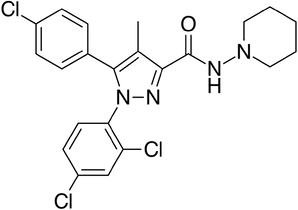
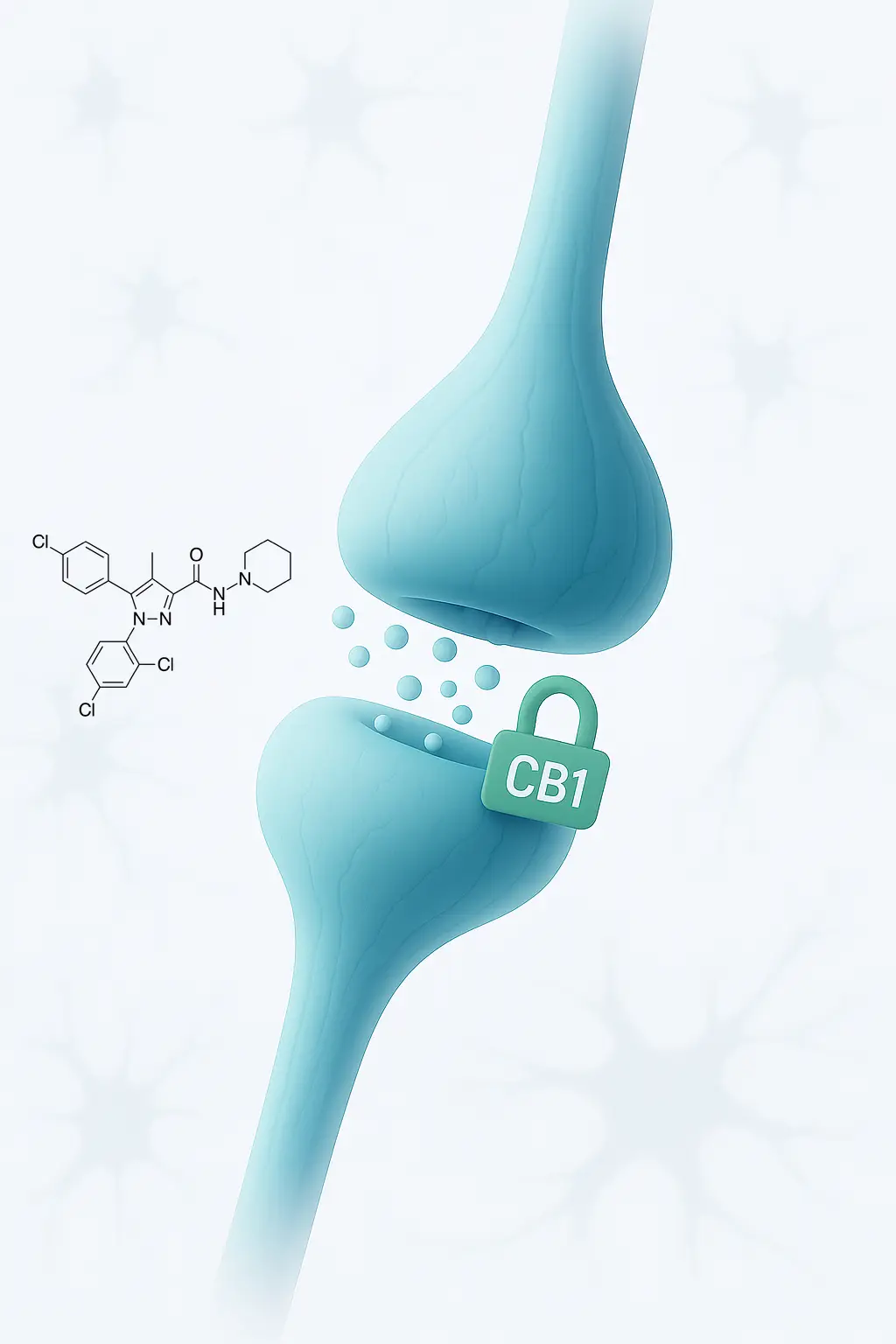
Chemical structure of SR141716A (Rimonabant)
Stage of development
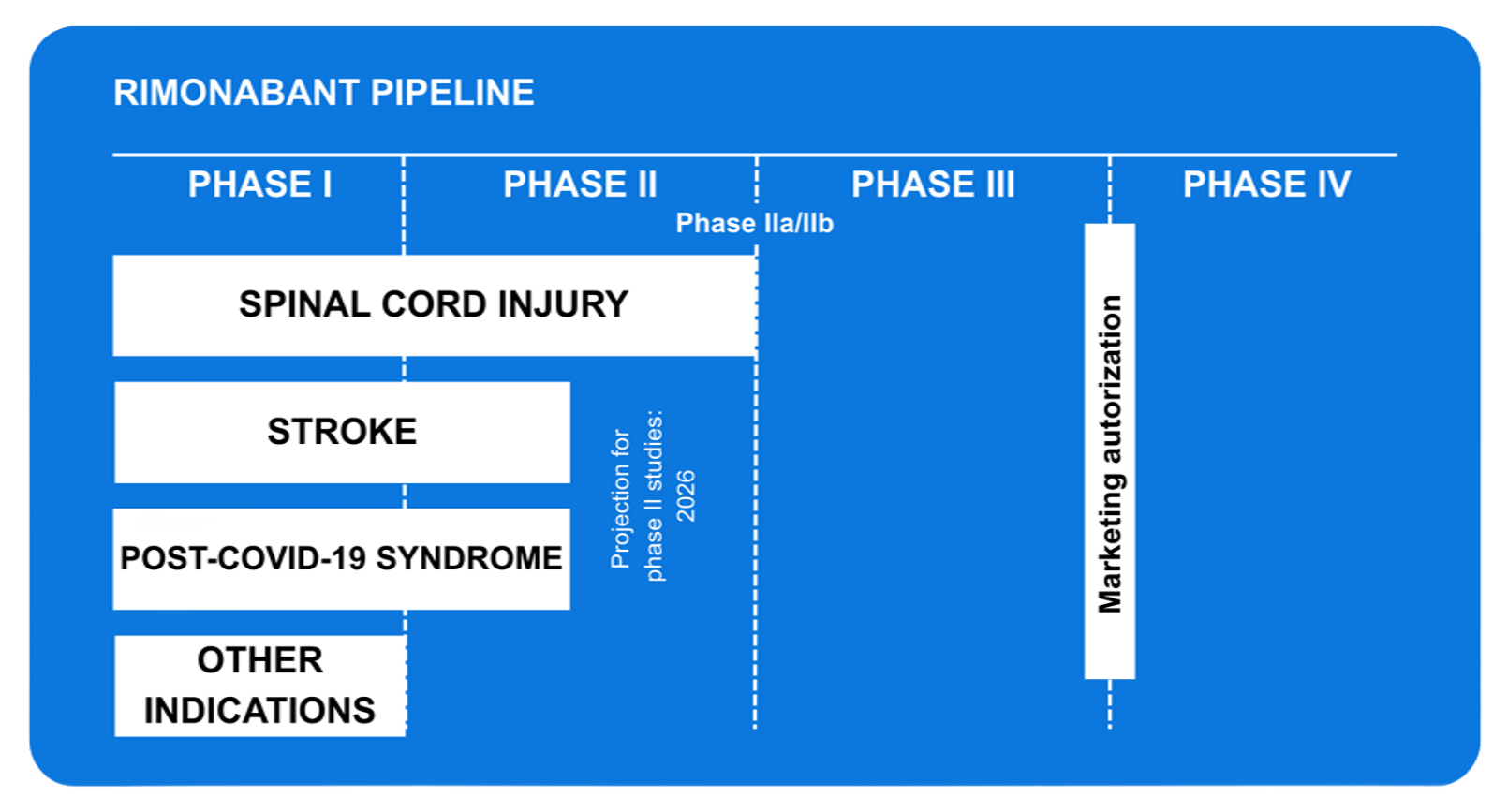
The rimonabant project in Sinfatin is located at:
- Clinical phase
It is currently in the intermediate phase of clinical development, evaluating its efficacy and therapeutic application in phase II and IIb studies. - Priority lines of application:
- Ictus
- Spinal cord injury
- Post-COVID-19 syndrome
- Other possible applications
Potential benefits of Rimonabant
- Modulation of the endocannabinoid system by increasing excitability in motor neurons
- Improvement of motor function after spinal cord injury.
- Known safety profile that facilitates its development for new indications.
Pipeline
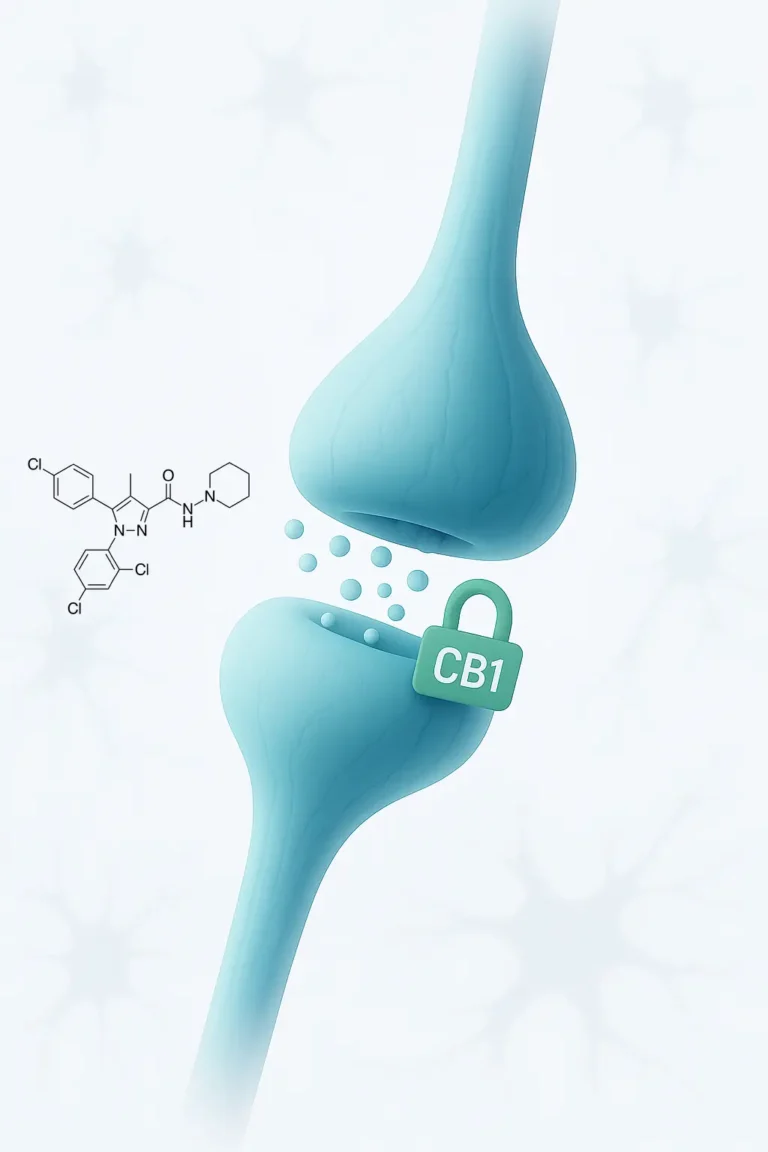
Mechanism of action of Rimonabant
Rimonabant functions as a CB1 receptor antagonist/inverse agonist, primarily targeting receptors located in the central nervous system.
These receptors are an integral part of the endocannabinoid system, which plays a crucial role in regulating neurotransmission.
Normally, endocannabinoids activate CB1 receptors to inhibit neurotransmitter release. However, when rimonabant blocks these receptors, it increases the release of neurotransmitters, especially glutamate.
This action increases neuronal excitability, which is especially beneficial for improving the functionality of the motor system in people who have deterioration resulting from conditions such as spinal cord injuries or strokes.
If you would like more information about this drug, please contact us.
We work to improve the lives of those living with central nervous system disorders by mitigating fatigue due to damage to motor systems.
Our commitment is to move toward more effective, safe, and accessible treatments.